Problem
Traditional corporate and sales training programs, especially those delivered through eLearning platforms, often lack immediate feedback and offer no meaningful way to analyze learner responses quantitatively.
As a result, learners receive limited guidance on how to improve in real time, and instructional designers miss the opportunity to understand learner thinking or measure the effectiveness of reflection-based training.
Solution
To address this gap, I designed a custom Node.js API and embedded it directly into an Articulate Storyline course. This API analyzes learners' free-text reflection responses using a language model and provides immediate, personalized feedback based on their input.
The approach not only enhances learner engagement and promotes metacognitive thinking, but also lays the groundwork for scalable, data-driven evaluation of learning patterns in corporate training.
Design Process
Build a scenario-based module
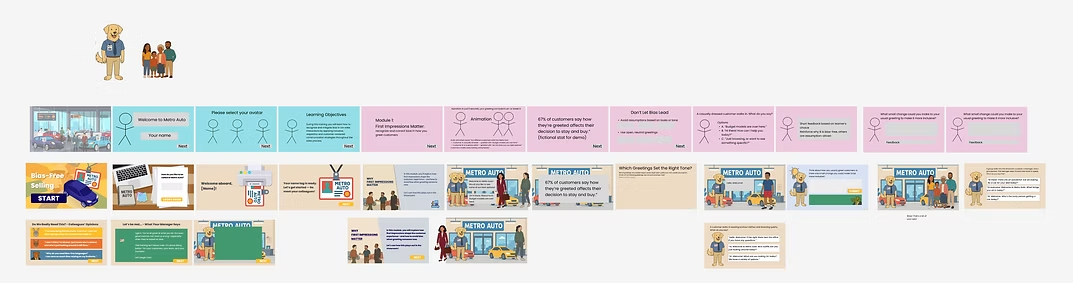
The course was developed as a scenario-based example to serve as a practical testbed for embedding and demonstrating this custom API within a real eLearning environment. By building a lightweight yet realistic module in Articulate Storyline, I simulated how a corporate training course could deliver personalized, real-time feedback on learner reflections, powered by a backend I built using Node.js and OpenAI.
Ground it in learning science
Despite being a demonstration, the course content is grounded in learning sciences. I used the Backward Design model to ensure alignment between learning goals, instructional activities, and assessment. The course includes:
- Clearly defined learning objectives centered on bias mitigation in sales interactions
- Scenario-based branching content designed to reflect realistic workplace decisions
- Assessments including multiple choice, self-reflection, and scenario practice
- Immediate feedback powered by my custom API
- Fully custom visual and character design, built in Figma and implemented in Storyline
AI-powered immediate feedback
The steps below illustrate the end-to-end flow of the AI-powered feedback system embedded in the course: a learner submits a reflection, receives feedback in real time, and experiences differentiated responses based on the quality and confidence of their input.
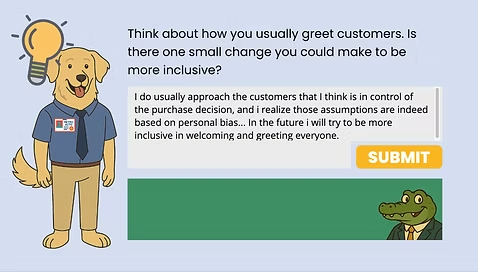
Learner reflects and submits
The learner reflects on their greeting habits in customer interactions. In this example, they recognize a bias in who they prioritize and express intent to be more inclusive. This free-text input is evaluated by the AI feedback grader.
Affirming feedback
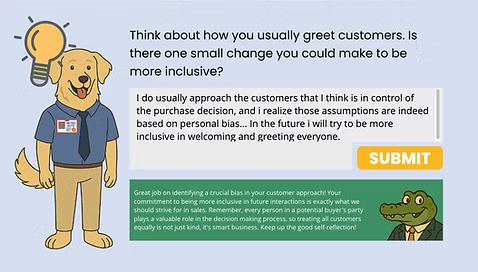
After submission, the system returns tailored, affirming feedback. The API acknowledges the learner's insight and reinforces inclusive behaviors with a supportive message, encouraging further growth.
Empathetic encouragement
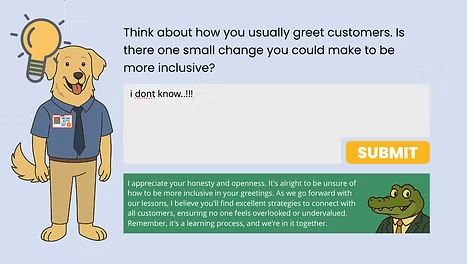
If the learner submits an unsure or minimal response, the feedback grader offers empathetic encouragement instead. Rather than penalizing uncertainty, the system reassures the learner and sets expectations for future lessons.
Live prototype
This is the finished demo module, with the AI feedback API embedded live: reflect on the prompt to see the personalized feedback in action.
Why it matters
This project shows what's possible when instructional design and software development meet: reflection-based training that used to be a one-way broadcast becomes a real conversation, at scale, without needing a live facilitator in the room.